
Medically reviewed by Dr. Belis Aladag, MD, MPH, FASAM
Naltrexone is a prescription medication used in the treatment of alcohol use disorder and opioid use disorder. It is not an opioid, it is not addictive, and it does not produce a high. Instead, it works by blocking the receptors in the brain that alcohol and opioids act on, which can make drinking or using feel less rewarding and reduce cravings over time.
If you have been searching for “what is naltrexone,” you are probably trying to understand whether it is something that could fit into your own recovery or a loved one’s. This guide explains what naltrexone is, how it works, the forms it comes in, what side effects people commonly report, and how it is used alongside counseling and support. It is written for education, not as medical advice. Whether naltrexone is appropriate for any individual is a decision for that person and a licensed prescriber.
Recovery doesn’t have to mean leaving home. Learn how Hart’s in-home program works.
Quick facts about naltrexone
- What it is: an opioid antagonist, meaning it blocks opioid receptors rather than activating them.
- What it is used for: alcohol use disorder and opioid use disorder, as one part of a treatment plan.
- Forms: a daily oral tablet (brand names included ReVia and Depade) and a monthly extended-release injection (brand name Vivitrol).
- Is it addictive? No. Naltrexone has no abuse potential and does not cause physical dependence.
- Is it the same as Suboxone or methadone? No. Those medications activate opioid receptors; naltrexone blocks them.
How does naltrexone work?
Alcohol and opioids both trigger the release of endorphins and dopamine, the brain’s natural reward chemicals. Over time, the brain begins to associate drinking or using with that reward, and cravings are the brain’s way of asking for it again.
Naltrexone attaches to the brain’s opioid receptors and sits there without activating them. With the receptors occupied, opioids cannot produce their usual effect, and the endorphin release that normally accompanies alcohol is blunted. In plain terms, the “payoff” the brain expects doesn’t arrive in the same way. For many people this makes it easier to drink less or not at all, and over weeks and months it can weaken the learned link between the substance and reward.
A few things naltrexone does not do are worth spelling out, because they come up constantly in searches:
- It does not make you sick if you drink, the way disulfiram (Antabuse) does.
- It does not stop alcohol from impairing you. Someone taking naltrexone who drinks is still intoxicated, still impaired to drive, and still at risk of alcohol poisoning.
- It does not treat withdrawal symptoms. Naltrexone is generally started after detox, not during it.
Naltrexone for alcohol use disorder
Naltrexone is one of three medications approved by the U.S. Food and Drug Administration for alcohol use disorder, alongside acamprosate and disulfiram. In research summarized by the National Institute on Alcohol Abuse and Alcoholism, people taking naltrexone tended to have fewer heavy-drinking days and lower relapse rates than people taking a placebo, especially when the medication was combined with counseling.
Unlike some older approaches, naltrexone does not require a person to be fully abstinent before starting, which is one reason prescribers sometimes use it for people whose goal is to cut back rather than quit entirely. The “Sinclair Method” you may have seen online refers to a specific approach of taking naltrexone before drinking; it is one of several ways the medication has been studied and used.
Naltrexone for opioid use disorder
For opioids, naltrexone works as a blocker: while it is active in the body, heroin, fentanyl, oxycodone, and other opioids are largely unable to produce their effects. This is why it must be started only after a person has fully cleared opioids from their system, typically seven to ten days after the last short-acting opioid and longer for methadone or buprenorphine. Starting too early can trigger sudden, intense withdrawal (sometimes called precipitated withdrawal), which is one of the main reasons the timing is managed by a prescriber.
Because naltrexone contains no opioid, it is sometimes chosen by people who want a medication-assisted option without a daily controlled substance, or who work in fields where buprenorphine or methadone would be complicated.
Naltrexone vs. Vivitrol: what’s the difference?
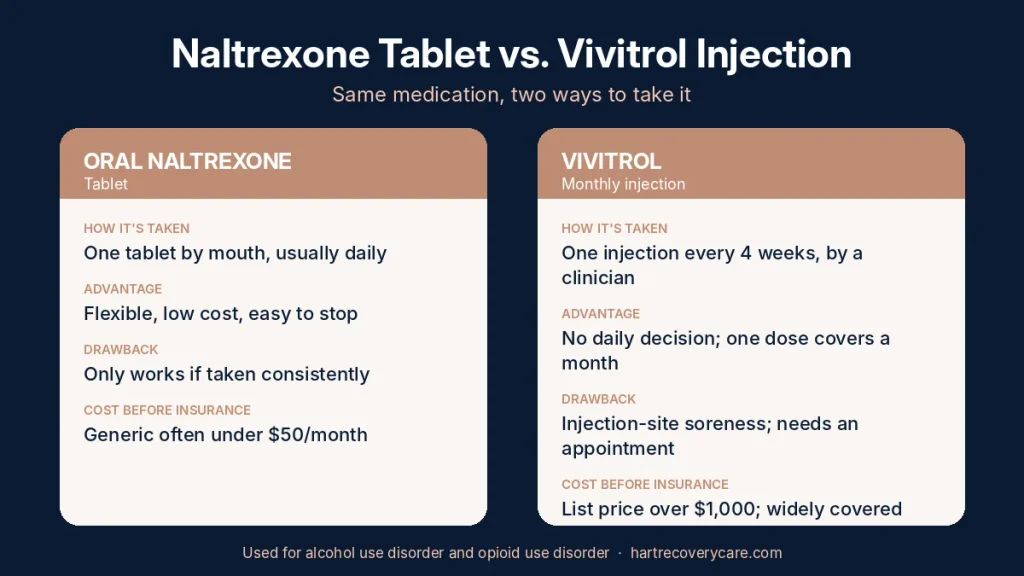
Vivitrol is naltrexone. It is the brand name for the extended-release injectable form, given once a month by a healthcare provider. The oral tablet is the same active ingredient taken daily. People searching “naltrexone vs Vivitrol” are usually comparing the two forms, so here is how they differ in practice.
| Oral naltrexone (tablet) | Vivitrol (monthly injection) | |
|---|---|---|
| How it’s taken | One tablet by mouth, typically daily | One injection into the muscle every 4 weeks, given by a clinician |
| Main advantage | Flexible, inexpensive, easy to stop | Removes the daily decision; one dose covers the month |
| Main drawback | Only works if taken consistently | Injection-site soreness; requires a clinic or home-visit appointment |
| Typical cost (U.S., before insurance) | Generic tablets are usually under $50/month | List price is well over $1,000/month; most insurance plans and Medi-Cal cover it |
| Used for | Alcohol use disorder, opioid use disorder | Alcohol use disorder, opioid use disorder |
Neither form is “better” across the board. Prescribers generally weigh how consistently a person can take a daily medication, cost and coverage, and personal preference.
Who is naltrexone typically prescribed for?
Naltrexone is usually considered for adults who:
- Have been diagnosed with alcohol use disorder or opioid use disorder
- Have completed detox or are no longer physically dependent on opioids
- Want help reducing cravings as part of a broader plan that includes counseling, peer support, or both
It is generally not used for people who are currently taking opioid pain medication, who need opioids for an upcoming surgery, who are in acute withdrawal, or who have significant liver disease. People who are pregnant or breastfeeding are evaluated case by case. A prescriber will review medical history, current medications, and liver function before starting it, and will usually confirm that opioids are out of the system first.
Naltrexone side effects
Most people tolerate naltrexone well, and side effects that do occur are often mild and tend to ease within the first couple of weeks. The most commonly reported ones are:
- Nausea or stomach upset
- Headache
- Dizziness or fatigue
- Trouble sleeping
- Anxiety or nervousness
- Soreness, redness, or swelling at the injection site (Vivitrol)
Less common but more serious concerns include liver irritation at high doses, allergic reactions, and, for people with opioid use disorder, a reduced tolerance to opioids. That last point matters: because naltrexone blocks opioids, a person who stops taking it and returns to their previous dose can overdose more easily than before. This is a standard warning every prescriber discusses, and it is one reason naltrexone is paired with ongoing support rather than handed out on its own.
Anyone experiencing severe stomach pain, yellowing of the skin or eyes, dark urine, or signs of an allergic reaction while taking naltrexone should contact their prescriber or seek urgent care.
How long do people take naltrexone?
There is no fixed timeline. Some people use it for a few months to get through the highest-risk period after detox; others stay on it for a year or longer. Research on alcohol use disorder has generally studied naltrexone over periods of three to twelve months. The length of treatment is something a person and their prescriber revisit together based on how things are going.
Does naltrexone work on its own?
Naltrexone is most effective as one part of a plan. In the studies that show the strongest results, it is combined with some form of counseling, behavioral therapy, or structured support. The medication can quiet cravings; it does not change routines, relationships, stress, or the reasons someone started drinking or using in the first place. Those parts of recovery still need attention.
Naltrexone and at-home addiction treatment
One of the practical advantages of naltrexone is that it does not require a person to live at a facility. Because it is non-addictive and not a controlled substance, it can be prescribed and monitored in an outpatient or in-home setting once a person has safely completed detox.
At Hart Recovery Care, naltrexone is one of the medication options our clinical team may discuss with clients in our in-home addiction treatment program across Fresno, Bakersfield, Stockton, Modesto, Visalia, and the Central Valley. Our medical providers evaluate whether it fits a client’s history and goals, handle the prescription and follow-up, and pair it with the counseling and family support that the research says makes the difference. Learn more about medication-assisted treatment at home or verify your insurance to see what’s covered.
If you or someone you love is considering naltrexone, the next step is a conversation with a licensed provider who can review your full picture. Contact Hart Recovery Care to talk confidentially with our team.
Frequently asked questions about naltrexone
Is naltrexone addictive? No. Naltrexone is an opioid blocker, not an opioid. It has no abuse potential, does not cause a high, and does not create physical dependence.
Can you drink alcohol while taking naltrexone? Drinking on naltrexone does not cause the sickness that disulfiram (Antabuse) does, and some treatment approaches start it while a person is still drinking. However, alcohol still impairs you fully. Whether and how to use naltrexone around drinking is something to discuss with a prescriber.
How long does naltrexone take to work? The oral tablet begins blocking receptors within about an hour. Reduced cravings are something many people notice over the first several weeks rather than the first day.
How long does naltrexone stay in your system? Oral naltrexone is generally active for about 24 to 72 hours depending on the dose. The Vivitrol injection releases naltrexone steadily for roughly four weeks.
What happens if you take opioids while on naltrexone? The opioids are largely blocked and will not produce their usual effect. Trying to override the block with larger doses is dangerous and can cause overdose, especially once the medication wears off.
Is naltrexone the same as Suboxone? No. Suboxone contains buprenorphine, which partially activates opioid receptors. Naltrexone blocks them entirely and contains no opioid.
Does insurance cover naltrexone? Generic oral naltrexone is inexpensive and widely covered. Vivitrol is covered by most commercial plans and by Medi-Cal in California, often with prior authorization. Hart Recovery Care can verify your benefits for you.
This article is for general educational purposes and is not a substitute for medical advice, diagnosis, or treatment. Always consult a licensed healthcare provider about any medication.
Questions about treatment at home? Reach out to Hart Recovery Care for a private, no-pressure conversation.