
Medically Reviewed by Dr. Belis Aladag, MD, MPH, FASAM — H.A.R.T. Recovery Care
If you are reading this because you are thinking about stopping fentanyl, there is a good chance the withdrawal is what scares you most.
Maybe you have tried before and did not make it very far. Maybe you have heard stories about Suboxone making withdrawal suddenly worse. Maybe leaving home for detox simply is not realistic because of work, children, family responsibilities, or privacy.
Those are important questions to answer before you stop.
Fentanyl withdrawal can be physically and emotionally intense. Body aches, stomach problems, insomnia, anxiety, restlessness, and cravings can all happen at the same time. The most difficult symptoms often occur during the first several days, although fentanyl does not follow exactly the same timeline for everyone.
There is also an important distinction that gets lost in many conversations about detox:
Going through fentanyl withdrawal at home by yourself is not the same as receiving medically supervised treatment in your home.
For people who are clinically appropriate for outpatient care, medical and behavioral health treatment may be able to come to them instead.
If you are worried about stopping fentanyl and want to understand your options, call H.A.R.T. Recovery Care at (559) 314-2148 for a confidential conversation.
What Does Fentanyl Withdrawal Feel Like?
Fentanyl withdrawal is rarely one isolated symptom.
It can feel like a severe case of the flu combined with anxiety, restlessness, cravings, and an inability to sleep.
Physical symptoms may include:
- Muscle and bone aches
- Restless legs
- Sweating
- Chills
- Goosebumps
- Runny nose
- Watery eyes
- Frequent yawning
- Nausea
- Vomiting
- Diarrhea
- Stomach cramps
- Dilated pupils
- Increased heart rate
- Elevated blood pressure
- Insomnia
There is also a psychological side to withdrawal.
Anxiety can become intense. Some people feel irritable, agitated, depressed, unable to concentrate, or preoccupied with using fentanyl again.
Someone may be completely exhausted and still unable to sleep. Their body hurts. Their stomach is upset. They cannot get comfortable.
At the same time, they know using fentanyl again could temporarily make those symptoms disappear.
That is part of what makes withdrawal so difficult to manage alone.
How Soon Does Fentanyl Withdrawal Start?
There is no universal countdown clock.
Symptoms can begin after someone stops using fentanyl, but the timing varies based on factors such as:
- How frequently fentanyl was used
- How much was used
- How long the person has been using it
- Their metabolism
- Previous withdrawal experiences
- Other substances being used
Fentanyl is also highly lipophilic, meaning it can accumulate in fatty tissue after repeated exposure. That has made both withdrawal and the transition to medications such as buprenorphine less predictable than older opioid-withdrawal timelines sometimes suggest.
In practical terms:
Someone’s previous experience stopping heroin, oxycodone, or another opioid may not predict exactly what fentanyl withdrawal will be like.
What Is the Fentanyl Withdrawal Timeline?
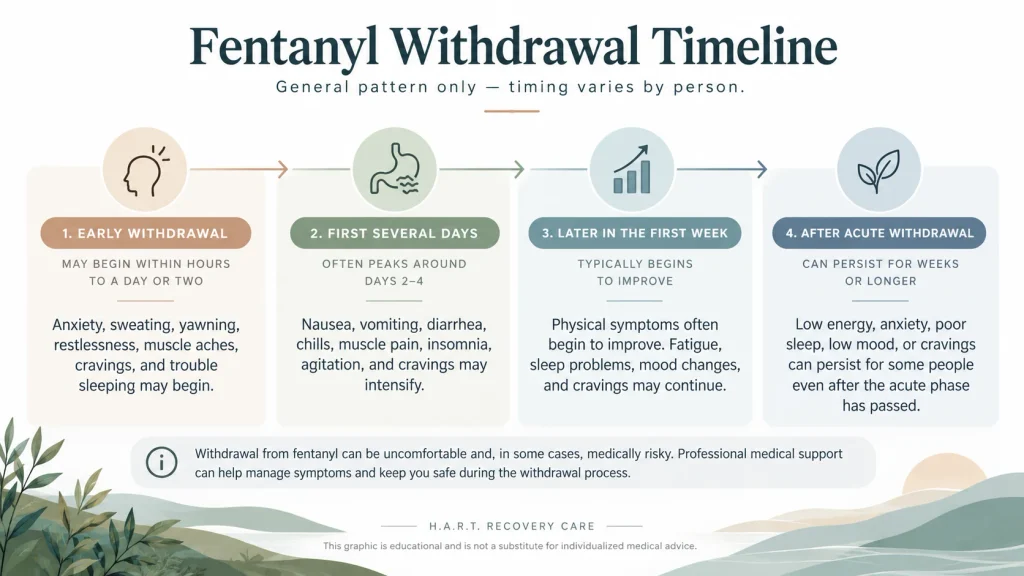
It is more useful to think of fentanyl withdrawal as a general progression than an exact schedule.
| Stage | What Someone May Experience |
|---|---|
| Early withdrawal | Anxiety, sweating, yawning, runny nose, restlessness, muscle aches, cravings, and difficulty sleeping may begin. |
| First several days | Symptoms may become significantly more intense. Nausea, vomiting, diarrhea, chills, muscle pain, insomnia, agitation, and strong cravings can occur. |
| Later in the first week | Physical symptoms often begin improving, although fatigue, sleep problems, mood changes, and cravings may continue. |
| After acute withdrawal | Some people continue experiencing low energy, anxiety, poor sleep, low mood, or cravings after the strongest physical symptoms have improved. |
The exact timeline can be shorter or longer.
More important than matching an online timeline is paying attention to what is actually happening.
Can the person keep fluids down?
Are symptoms getting better or worse?
Are other substances involved?
Are they medically stable?
Are they becoming confused, severely depressed, or unable to function safely?
Those questions matter more than whether someone is on “day two” or “day four.”
Why Can Fentanyl Withdrawal Be Hard to Predict?
There are several reasons.
First, illicit fentanyl is not a standardized medication. Someone using counterfeit pills or powder may not know exactly how much fentanyl is present or what else has been mixed into it.
Second, fentanyl is extremely potent.
Third, repeated fentanyl exposure can complicate both the withdrawal process and the way medications such as buprenorphine are introduced.
Two people who both say, “I use fentanyl every day,” can therefore have very different experiences when they stop.
Fentanyl Withdrawal vs. Other Opioid Withdrawal
People frequently ask whether fentanyl withdrawal is worse than heroin or prescription opioid withdrawal.
There is no single answer that applies to everyone.
The more useful distinction is that fentanyl withdrawal can be less predictable.
| Fentanyl | Other Short-Acting Opioids | |
|---|---|---|
| Drug supply | Often difficult to know exactly what was taken | May be more predictable, particularly when prescribed |
| Potency | Extremely high | Varies |
| Withdrawal timing | Can be harder to predict | May follow a more familiar pattern |
| Buprenorphine initiation | May require a more individualized strategy | Traditional initiation may sometimes be more straightforward |
| Overdose risk after abstinence | A major concern as tolerance falls | Also a serious concern |
Someone who has stopped oxycodone or heroin in the past should not assume fentanyl will behave exactly the same way.
What Is Usually the Hardest Part of Fentanyl Withdrawal?
For many people, it is not one dramatic symptom.
It is having multiple symptoms continue hour after hour.
Not sleeping.
Not being able to get comfortable.
Switching between sweating and chills.
Stomach problems.
Muscle aches.
Anxiety.
Cravings.
And knowing that using fentanyl again could temporarily stop much of it.
Returning to use during withdrawal should not be reduced to a matter of willpower.
Physical dependence creates an extremely strong biological incentive to make the withdrawal stop.
Treatment is intended to make that process safer and more manageable.
Is Fentanyl Withdrawal Dangerous?
Opioid withdrawal is generally different from severe alcohol or benzodiazepine withdrawal, which can directly cause seizures and other life-threatening complications.
That does not mean fentanyl withdrawal is harmless.
Dehydration
Repeated vomiting and diarrhea can make it difficult to maintain adequate fluids and electrolytes.
Existing medical conditions
Withdrawal places stress on the body. Heart disease, kidney problems, liver disease, respiratory conditions, and other medical issues can affect how safely someone can be treated.
Mental health symptoms
Anxiety and depression can become worse during withdrawal.
Suicidal thoughts or severe psychiatric symptoms require immediate help.
Other substances
A person may also be dependent on alcohol, benzodiazepines, or other substances.
That changes the risk considerably.
Overdose after abstinence
One of the most important risks can occur after someone stops.
Tolerance to opioids begins to decrease during abstinence. Returning to an amount of fentanyl that the body previously tolerated can then cause an overdose.
The unpredictability of illicit fentanyl makes that risk even greater.
The National Institute on Drug Abuse (NIDA) reports that illicitly manufactured fentanyl and other potent synthetic opioids are involved in the vast majority of opioid-involved overdose deaths in the United States.
Naloxone should be available whenever opioid overdose is possible.
When Is Fentanyl Withdrawal an Emergency?
Call 911 or seek emergency medical care if someone:
- Is difficult or impossible to wake
- Has slowed, irregular, or stopped breathing
- Develops blue or gray lips or fingertips
- Has chest pain
- Faints
- Becomes severely confused
- Experiences a seizure
- Cannot keep fluids down and appears significantly dehydrated
- Expresses suicidal thoughts or intent
If an opioid overdose is suspected, administer naloxone if available and call 911.
Can You Detox From Fentanyl at Home?
Sometimes.
But the phrase “detox at home” can describe three very different situations.
Trying to Quit Fentanyl Alone
There is no professional monitoring, no clinician managing medications, and usually no established plan if symptoms become more severe than expected.
Receiving Medically Supervised Treatment at Home
The person remains in their normal environment, but treatment is directed by medical professionals.
Depending on the treatment plan, that may involve clinical assessment, withdrawal monitoring, medication management, behavioral health care, and a plan for moving to a higher level of care if the home setting becomes unsafe.
Entering a Hospital or Residential Detox Program
The person temporarily leaves home and receives treatment in a facility with a different level of structure and monitoring.
These are not interchangeable.
Fentanyl Detox Options Compared
| Alone at Home | Receiving Clinician-Guided Treatment at Home | Facility-Based Detox | |
|---|---|---|---|
| Medical assessment | No | Yes | Yes |
| Professional withdrawal monitoring | No | Yes | Yes |
| Medication management | Self-directed or none | Clinician-directed | Clinician-directed |
| Stay in your own home | Yes | Yes | No |
| Maintain privacy at home | Yes | Yes | No |
| Formal escalation plan | Usually no | Yes | Yes |
| Appropriate for higher medical risk | No | Depends on assessment | Often |
| Behavioral health support | Self-directed | Can be integrated into care | Often available |
| Continued treatment after detox | Must arrange independently | Can continue through the treatment plan | Requires discharge/transition planning |
For many people searching for information about fentanyl detox at home, the real issue is not that they do not want medical help.
They may not want—or may not realistically be able—to leave their family, work, or home life for residential treatment.
For some patients, medically supervised in-home detox may offer another option.
Do You Have to Go to Rehab to Stop Using Fentanyl?
Not necessarily.
Residential treatment is appropriate for some people and necessary in certain circumstances.
It is not the only legitimate treatment setting.
Depending on someone’s health, withdrawal risk, other substance use, mental health, home environment, and available support, treatment may be provided on an outpatient basis.
For qualifying patients, some of that care can be delivered in the home.
The appropriate setting should be determined through a clinical assessment rather than assuming everyone needs the same type of treatment.
Who May Be Appropriate for Fentanyl Detox at Home?
A website cannot safely make that determination.
A clinician needs to understand the full picture, including:
- Current fentanyl use
- Frequency and duration of use
- Other drugs or alcohol involved
- Previous withdrawal experiences
- Previous overdoses
- Medical conditions
- Mental health history
- Current medications
- Pregnancy
- Home environment
- Available family or social support
The purpose of the assessment is not to find a way to make home detox work for everyone.
It is to determine whether home is actually an appropriate setting for that individual.
When Is Home Detox Not the Right Choice?
There are situations where a hospital or residential setting may be safer.
Those may include serious medical instability, complications after an overdose, severe psychiatric symptoms, an unsafe home environment, or dependence on substances such as alcohol or benzodiazepines that can produce dangerous withdrawal complications.
Pregnancy and certain medical conditions may also require a different level of monitoring.
A responsible in-home treatment program should be willing to tell someone when treatment at home is not appropriate.
That is part of good care.
Does Suboxone Help With Fentanyl Withdrawal?
Buprenorphine is one of the most important medications used to treat opioid use disorder.
Suboxone is a brand-name medication containing buprenorphine and naloxone.
According to SAMHSA guidance on buprenorphine, buprenorphine can reduce opioid withdrawal symptoms and cravings and may be continued as ongoing treatment when clinically appropriate.
Fentanyl has complicated one part of that process:
When and how buprenorphine should be started.
How Long After Fentanyl Can You Take Suboxone?
There is no safe universal answer such as “wait exactly 12 hours” or “wait exactly three days.”
That is important because people searching online will find many conflicting timelines.
Clinicians consider factors such as:
- Current withdrawal symptoms
- Recent fentanyl exposure
- Pattern of opioid use
- Previous experiences with buprenorphine
- Medical history
- Other substances involved
People exposed to high-potency synthetic opioids such as fentanyl may sometimes require a more individualized buprenorphine initiation strategy.
The American Society of Addiction Medicine (ASAM) notes that people exposed to high-potency synthetic opioids such as fentanyl may require individualized approaches to buprenorphine initiation.
The decision should be based on the patient—not only on the number of hours since their last fentanyl use.
Buprenorphine can reduce opioid withdrawal symptoms and cravings and may be continued as ongoing treatment when clinically appropriate. Learn more about private Suboxone treatment at home in California.
What Is Precipitated Withdrawal?
Precipitated withdrawal is a sudden worsening of opioid withdrawal that can occur when buprenorphine is introduced at the wrong point in the process.
Symptoms can develop quickly and may feel dramatically worse than the withdrawal the person was already experiencing.
People who have experienced precipitated withdrawal are understandably afraid of experiencing it again.
But fear of precipitated withdrawal should not automatically mean avoiding buprenorphine.
Buprenorphine remains an evidence-based treatment for opioid use disorder.
The safer approach is individualized medical management rather than trying to determine the correct timing from internet advice.
What Does Medically Supervised Fentanyl Treatment at Home Actually Involve?
The important word is medical.
Being in your own bedroom does not make withdrawal less real.
A treatment team still needs to understand what is happening and recognize when the original plan needs to change.
Depending on the patient’s treatment plan, the clinical team may monitor:
| What May Be Monitored | Why It Matters |
|---|---|
| Heart rate and blood pressure | Withdrawal can activate the body’s stress response |
| Hydration | Vomiting and diarrhea can cause significant fluid loss |
| Withdrawal symptoms | Helps clinicians assess severity and progression |
| Medication response | Treatment may need to be adjusted |
| Mood and mental status | Anxiety, depression, or agitation may worsen |
| Cravings | Strong cravings can increase the risk of returning to use |
| Overall medical stability | Helps determine whether home remains an appropriate setting |
If symptoms become too severe or the patient’s condition changes, treatment may need to move to a higher level of care.
Recognizing when home is no longer the right environment is one of the biggest differences between medical treatment and attempting to detox alone.
What Makes H.A.R.T. Recovery Care Different?
H.A.R.T. Recovery Care was built around a straightforward idea:
People should not always have to leave their home and everyday environment to receive meaningful addiction treatment.
Withdrawal management can be part of that care, but it does not have to be where treatment ends.
When clinically appropriate, H.A.R.T.’s in-home model can continue into areas such as:
- Medications for opioid use disorder
- Individual therapy
- Peer recovery support
- Family involvement
- Relapse-prevention planning
- Mental health support
- Ongoing care coordination
That continuity is important.
The person who first reaches out because they are afraid of fentanyl withdrawal may eventually need help managing cravings, rebuilding sleep, addressing anxiety or trauma, repairing relationships, or learning how to live differently without fentanyl.
Those issues do not disappear when the stomach symptoms and body aches stop.
Can You Work While Detoxing From Fentanyl?
Maybe, but planning to function normally during acute withdrawal may be unrealistic.
Withdrawal can involve insomnia, stomach problems, muscle pain, anxiety, fatigue, and difficulty concentrating.
In-home treatment eliminates the disruption of checking into a facility, but it does not eliminate the need for recovery time.
When possible, reduce work obligations during the most difficult part of withdrawal.
For professionals, parents, business owners, and caregivers, the benefit of treatment at home is flexibility.
It is not the expectation that withdrawal will have no impact on everyday life.
What If You Have Children at Home?
Being able to stay home can matter enormously to parents.
But staying home does not necessarily mean someone can parent normally throughout acute withdrawal.
Additional childcare or family support may be useful during the most difficult days.
A supportive adult in the home may also help communicate with the treatment team and notice changes the patient may not recognize themselves.
When appropriate and with the patient’s permission, family involvement can become part of the broader treatment plan.
What Helps With Fentanyl Withdrawal at Home?
Medical care should come first.
Basic comfort measures can help make withdrawal more manageable:
- Small, frequent amounts of water or electrolyte drinks
- Simple foods when eating feels possible
- Warm showers or baths for muscle discomfort
- A quiet, comfortable sleeping environment
- Gentle movement when tolerated
- Support from a trusted family member or friend
These measures may improve comfort.
They do not replace medical treatment.
Avoid trying to build your own detox medication plan from information found online.
Why Is It So Hard to Sleep During Fentanyl Withdrawal?
Insomnia deserves more attention than it often receives.
Withdrawal can leave someone exhausted and restless at the same time.
Muscles hurt. Legs will not settle. Anxiety is high. Temperature regulation feels wrong. The stomach may be upset.
Then another night passes without meaningful sleep.
For some people, sleep deprivation becomes one of the symptoms most likely to push them back toward fentanyl.
Sleep often begins improving as the nervous system stabilizes, although it may take longer to normalize than some other physical symptoms.
Severe insomnia should be discussed with the treating clinician rather than self-treated with alcohol, benzodiazepines, or medications that were not prescribed as part of the treatment plan.
What Happens After Fentanyl Detox?
This may be the most important question in the article.
Getting through withdrawal is meaningful.
But withdrawal itself is not the reason opioid use keeps returning.
After the acute symptoms improve, people still need to deal with things like:
- Cravings
- Stress
- Mental health
- Relationships
- Trauma
- Triggers
- Work
- Family responsibilities
- Daily routines
- The role fentanyl had begun playing in their life
Ongoing treatment may include:
- Buprenorphine or another medication for opioid use disorder
- Individual therapy
- Mental health treatment
- Peer recovery support
- Family involvement
- Relapse-prevention work
- Continued medical care
SAMHSA’s TIP 63 guidance also emphasizes ongoing medication and treatment for opioid use disorder beyond the initial withdrawal period.
Learn more about medication-assisted treatment at home.
H.A.R.T.’s treatment model allows care to change as the patient’s needs change rather than treating detox as an isolated event that ends after several difficult days.
Private Fentanyl Withdrawal Treatment in Central California
H.A.R.T. Recovery Care provides in-home addiction treatment in Fresno and communities throughout its Central California service area.
For patients who meet the clinical criteria for treatment at home, care comes to them rather than requiring them to temporarily relocate to a treatment facility.
That can be especially meaningful for someone balancing recovery with:
- Family responsibilities
- A career
- Privacy concerns
- Caregiving responsibilities
- An established home life
Location alone does not determine eligibility.
Clinical appropriateness always comes first.
See all areas H.A.R.T. serves.
What Happens When You Call H.A.R.T.?
The first call is not a commitment to treatment.
It is a conversation.
The team needs to understand what someone is using, what has been happening, their health history, and what kind of help they are looking for.
From there, H.A.R.T. can determine what additional assessment is needed and whether in-home treatment may be appropriate.
If the person needs a different level of care, that should be recognized before an unsafe detox attempt begins.
If fear of withdrawal has been stopping you from asking for help, you do not need to have everything figured out before you call.
Call H.A.R.T. Recovery Care at (559) 314-2148 for a confidential conversation about your options.
Does Insurance Cover Fentanyl Treatment at Home?
Coverage depends on the insurance plan, medical necessity, and services being provided.
H.A.R.T. can review insurance benefits and explain available options before treatment begins.
Frequently Asked Questions About Fentanyl Withdrawal
How long does fentanyl withdrawal last?
The most intense symptoms often occur during the first several days after stopping fentanyl and then gradually improve. Sleep problems, fatigue, mood changes, and cravings may last longer. The timeline varies substantially between people.
What are the first signs of fentanyl withdrawal?
Early symptoms can include yawning, anxiety, sweating, runny nose, watery eyes, restlessness, muscle aches, cravings, and difficulty sleeping.
What is usually the worst day of fentanyl withdrawal?
There is no single worst day for everyone. Symptoms commonly become more intense during the first several days, but timing depends on fentanyl exposure, individual health, and whether other substances are involved.
Can fentanyl withdrawal kill you?
Opioid withdrawal itself is generally not fatal in an otherwise medically stable adult, but complications can become serious. Dehydration, medical conditions, withdrawal from other substances, psychiatric emergencies, and overdose after returning to fentanyl are important risks.
Can I detox from fentanyl at home?
Some patients may be appropriate for medically supervised in-home treatment after a clinical assessment. Trying to detox alone is very different from receiving professional withdrawal management in the home.
When can I take Suboxone after fentanyl?
There is no universal waiting period that is appropriate for everyone. Clinicians consider withdrawal symptoms, recent fentanyl use, medical history, and other factors when deciding how and when buprenorphine should be started.
Why can Suboxone cause precipitated withdrawal?
Buprenorphine binds strongly to opioid receptors. If it is introduced at the wrong point, it can cause opioid withdrawal symptoms to intensify quickly. Individualized medical supervision helps determine an appropriate initiation strategy.
Why can’t I sleep during fentanyl withdrawal?
Insomnia is common because withdrawal affects the nervous system while also causing anxiety, restlessness, body aches, stomach problems, and temperature changes. Sleep may remain disrupted after some other physical symptoms improve.
Can I work during fentanyl withdrawal?
It depends on the person and the severity of the withdrawal. Many people experience poor sleep, fatigue, physical symptoms, and difficulty concentrating during the acute phase. In-home treatment can provide flexibility, but recovery still requires time.
What if I also use Xanax, another benzodiazepine, or alcohol?
Tell the treating medical provider. Alcohol and benzodiazepine withdrawal can produce dangerous complications and may require a different level of medical monitoring than opioid withdrawal alone.
Do I have to go to residential rehab to stop using fentanyl?
Not everyone requires residential treatment. Some people may qualify for outpatient or in-home care, while others need hospital or residential treatment. A clinical assessment helps determine which setting is safest.
Is detox enough to treat fentanyl addiction?
No. Detox addresses acute physical withdrawal. Treatment for opioid use disorder often continues through medication, therapy, peer support, mental health care, family involvement, and relapse-prevention work.
Is at-home fentanyl treatment private?
In-home treatment allows eligible patients to receive care in their own environment instead of checking into a treatment facility. H.A.R.T.’s model is designed around individualized and confidential care delivered in the home.
Does insurance cover fentanyl addiction treatment?
Coverage varies by insurance plan, medical necessity, and the services provided. H.A.R.T. can verify benefits and explain available options before treatment begins.
You Do Not Have to Decide Everything Today
People sometimes delay asking for help because they believe making a phone call means they have already agreed to detox, medication, or residential rehab.
It doesn’t.
If you are using fentanyl and want to stop—or you are trying to help someone who does—the first useful question may simply be:
What is the safest way to do this?
H.A.R.T. Recovery Care can help determine whether medically supported treatment at home may be appropriate and what the next step could look like.
Call (559) 314-2148 for a confidential consultation.
This article is for educational purposes and does not replace individualized medical advice. If you believe someone is experiencing an overdose or another medical emergency, call 911.